
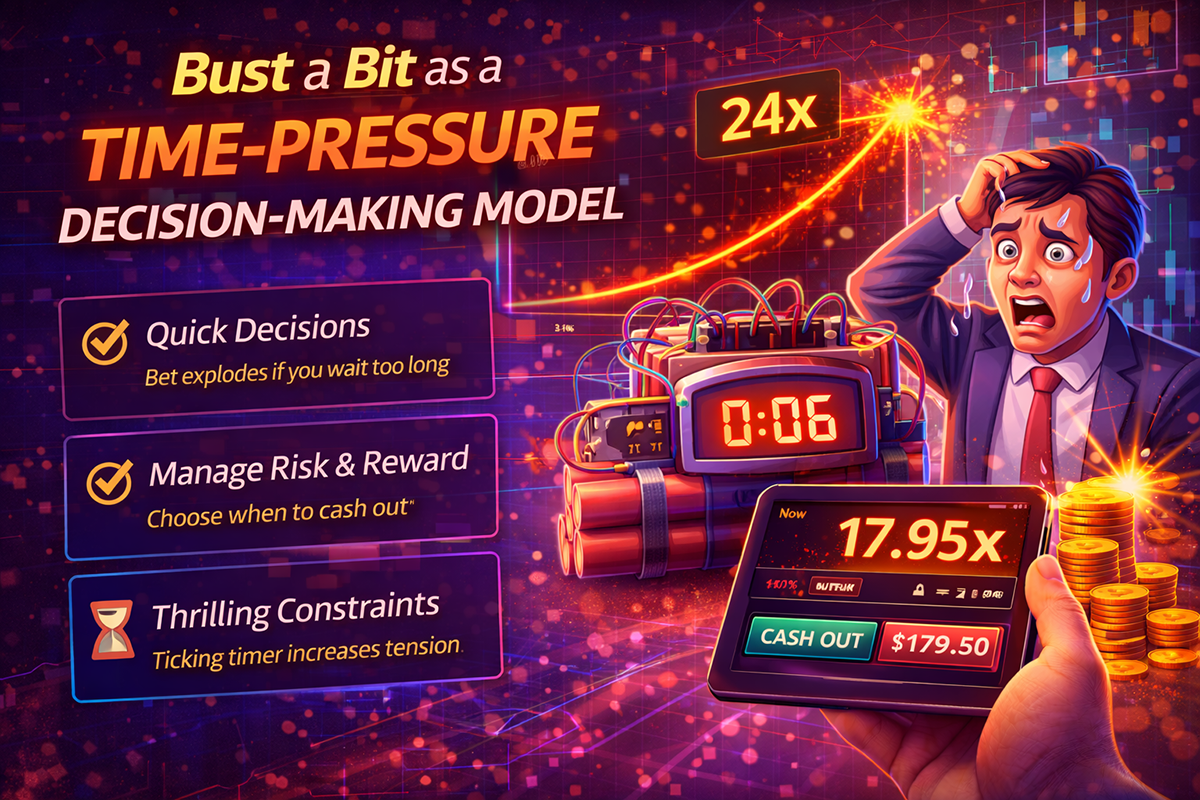
The crash game Bust a Bit is a simplified model of choice under uncertainty and tight timing. In each round, the player faces the same dilemma: take the money now or wait for a high multiplier, knowing that a delayed decision threatens to void the bet. During the game, there is no new input data and no opportunity to reconsider one’s behaviour. There is only time and the need to make a choice.
Next, we will discuss the logic of decision-making in Bust a Bit Game. The game is a visual behavioural model in which one can track a person’s actions under conditions of limited time and high cost of error. Each round forces you to make a decision without data for analysis. The player can only rely on internal expectations, fear of loss, and the desire to wait for a high odds ratio.
The Illusion of Real-Time Control
The feeling of control in Bust a Bit arises not from influencing the course of the round, but from the principle of user interaction with the game. Formally, the player makes the decision by pressing the exit button at any moment when the odds are increasing. As a result, it seems that the outcome depends on timing and strategy. In reality, the decision does not change either the round itself or the probability of its completion at a specific point.
What elements of the game create the illusion of control:
- A predetermined result. The moment of “crash” is calculated by the server before the start of the round. The increase in the coefficient on the graph is only a visualisation of the final outcome, not a process that can be influenced.
- Interactive selection point. The ability to exit at any time creates a sense of control, although in reality the player only chooses the point at which to withdraw funds.
- Smooth animation of growth. The continuous movement of the bet multiplier is interpreted by the brain as the development of the situation, although from the point of view of the logic of the game, nothing changes over time.
- Minimal time scale. Decisions are made in fractions of a second, reinforcing the belief that the outcome depends on the timeliness of the choice.
After the round is over, the illusion is reinforced by retrospective interpretation. The player sees the moment when the odds collapse and automatically associates it with their action — they left too early, almost managed to collect the money, stayed too long, and so on. A false cause-and-effect relationship arises between the choice and the outcome, although an alternative scenario was initially impossible.
Decision Without New Information
Decisions in Bust a Bit Game are made in conditions of information static. After the round starts, the player does not receive any new signals that could influence their assessment of the situation. The odds increase, but this does not provide any additional information, as it does not reflect probability and risk.
The game remains unchanged from the first to the last millisecond, which radically distinguishes Bust a Bit from most systems with which it is intuitively compared:
- Trading. The cost of an asset changes under the influence of demand, supply, volume, news and the behaviour of other participants. In a highly uncertain environment, the player constantly receives new data on the basis of which they can adjust their decision.
- Sports betting. The course of the match creates a flow of information – score, pace, injuries, substitutions, game episodes. Each event updates the context and changes the assessment of probabilities.
- Gambling. In card games, information about the cards that have been dealt appears; in slots, the payout structure and bonus incentives appear; and in live casinos, the dealer’s actions appear. With a certain mathematical expectation, the player receives signals for interpretation.
In Bust a Bit, there are no such signals. An increase in the multiplier does not reveal anything new about when the round will end. It does not reduce or increase the risk, but only visualises a pre-calculated outcome.
Strategy Under Time Pressure – What Actually Improves Long-Term Outcomes
When talking about the Bust a Bit strategy, it is important to understand that we are not talking about how to beat the system. The mathematical expectation of the round will be negative regardless of the tactics chosen. But in the long run, it is possible to minimise the destructive impact of decision-making errors, which is the only rational meaning of the strategy in a crash game:
- Fixed risk per round. The bet should be a small percentage of the bankroll – no more than 7-10%. This reduces losses from unsuccessful rounds and protects against emotional acceleration after a loss.
- Predetermined exit point. The decision to exit should be made before the start of the round, not during the growth of the odds. This prevents impulsive decisions and the depletion of your bankroll.
- Adequate target odds. Attempts to win rare x20-x50 odds create the illusion of potentially large profits, but in practice accelerate losses due to long losing streaks.
- Refusal to adapt to series. Changing your strategy after a few early or late “crashes” has no mathematical basis. Such adaptation is based on emotions, not information.
- Strict session limits. Time and loss limits are more important than any exit point. Most strategic mistakes are made not in a single round, but in a prolonged session.
The above principles do not increase the probability of winning in a particular round and do not change the distribution of outcomes. Their purpose is to prevent large losses and cognitive biases that lead to irrational decisions. By sticking to a strategy, you can maintain control over your decisions and increase your chances of making a profit in the long run.